
NGO Registration in India
Starting a new NGO in India? Whether you’re passionate about education, women empowerment, rural development, or climate action - registration is your first legal step to building impact. This guide covers everything you need to know for fresh NGO registration.
What Is an NGO?
An NGO (Non-Governmental Organization) is a non-profit entity that operates independently of government control to serve the public good. NGOs in India can be registered as:
- Trust
- Society
- Section 8 Company
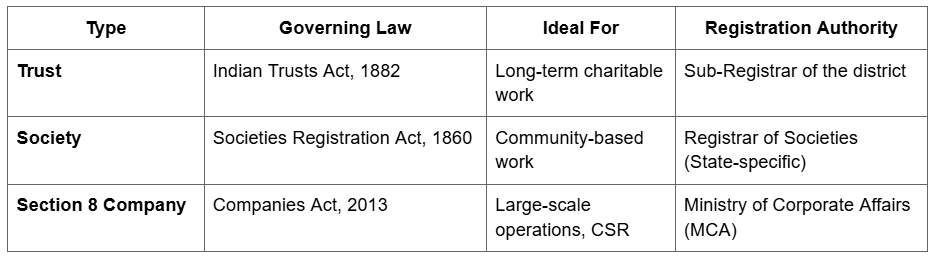
Types of NGO Structures You Can Register
Eligibility for Fresh NGO Registration
To register an NGO in India, you must:
- Be 18 years or older
- Have a clear objective of public service
Have at least 2 members (Trust), 7 members (Society), or 2 directors (Section 8 Company)
Step-by-Step NGO Fresh Registration Process:
Step 1: Choose Your Legal Structure
Decide between Trust, Society, or Section 8 Company based on:
- Scale of operations
- Funding needs (FCRA, CSR, etc.)
- Long-term goals
Step 2: Choose a Name
- Should not conflict with existing registered names
- For Section 8 companies, name approval is done via RUN (Reserve Unique Name) on the MCA portal
Step 3: Prepare Required Documents
- PAN & Aadhaar of all members
- Passport-sized photographs
- Proof of registered office (electricity bill + NOC from landlord)
- Trust Deed / MoA / AOA
- ID and address proof of trustees/members/directors
- Digital Signature Certificate (for Section 8)
Step 4: Draft Trust Deed / MoA & Rules
- Trust: Prepare a Trust Deed
- Society: Draft MoA and Rules & Regulations
- Section 8: Prepare Memorandum & Articles of Association (MOA/AOA)
Step 5: Submit Application
- Trust: Submit to local Sub-Registrar
- Society: Registrar of Societies (Assam in your case)
- Section 8: Online via MCA portal (SPICe+ form)
Step 6: Get Your NGO Registration Certificate
Once approved, you'll receive a Registration Certificate - your NGO’s legal identity.